A busy Saturday morning is not the time to discover that your card terminal has a weak signal, a flat battery, or cannot keep up with the queue. When owners ask, “which card machine is best for a small business?”, the useful answer is not a single model. It is the machine and payment setup that suits the way you actually serve customers, take orders, and manage the day.
For a hair salon, that may mean a simple portable terminal at the counter. For a cafe with table service, it may mean handheld ordering linked to an EPOS system. For a shop with a fixed till, a countertop terminal and clear sales reporting may be the sensible fit. Choosing well starts with your workflow, not the hardware.
Which card machine is best for a small business?
The right card machine should make taking payment quick for customers and straightforward for staff. It should also give you a clear view of costs and payouts without adding unnecessary administration.
Start by looking at where and how payment happens in your business. A market trader, plumber, or mobile beauty therapist needs a compact terminal that can travel with them. A restaurant needs reliable payment at the table, particularly when staff are moving between a busy dining room and outdoor seating. A bakery or convenience store may benefit from a fixed setup that keeps the counter moving during peak periods.
It also matters whether the card machine works on its own or as part of a wider system. A standalone terminal can be an excellent choice when you only need to take card payments. An integrated payment and EPOS setup can save more time when staff currently enter the same transaction into both a card machine and a till.
Begin with the customer journey
Think through a typical sale from start to finish. Where does the customer choose what they want? Where does the order get recorded? Where do they pay? And what has to happen after payment for the order to be completed?
In a small retail shop, this may be a short and simple sequence. The cashier scans or selects items, takes payment, and gives the customer a receipt. A countertop card machine next to the till is often practical here.
In a pub or restaurant, the process is more involved. Staff may take an order at a table, send it to the kitchen, add drinks later, split the bill, and then take payment. Handheld ordering and payment devices can reduce walking back and forth, while integrated systems can help avoid manual-entry mistakes between the till and terminal.
For a service business, payment may happen at the end of an appointment or after work is completed on site. A portable terminal is usually more flexible than asking customers to pay remotely later. Payment links or QR payments can also be useful in the right circumstances, such as collecting a deposit or giving a customer another convenient way to settle an invoice.
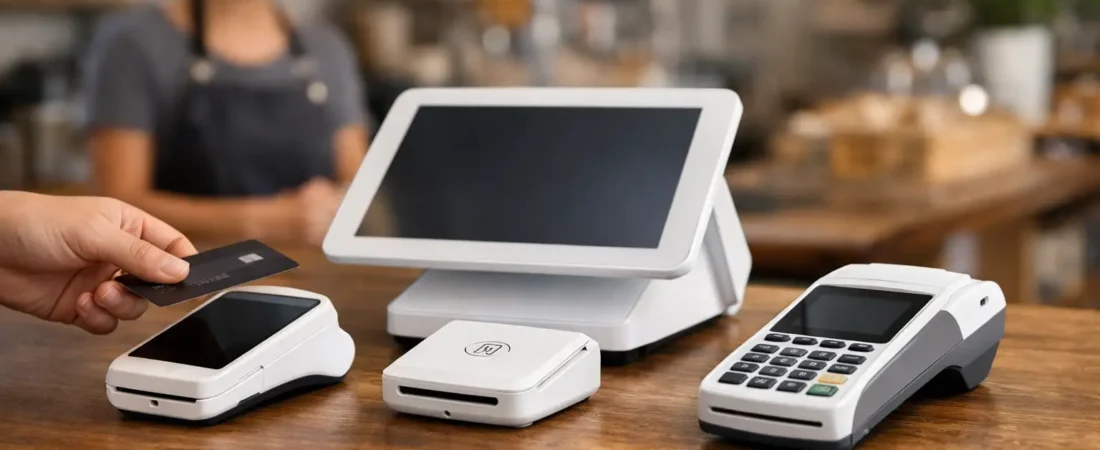
Choose the right type of card machine
There are three common starting points for independent businesses. The choice is usually clearer once you know whether payments happen in one fixed place, around the premises, or away from it.
Portable card terminals
Portable terminals are designed for businesses that need to take payment wherever the customer is. They suit tradespeople, market stalls, mobile services, guest houses, and businesses offering payment at tables.
Look at battery life, mobile or Wi-Fi connectivity, and how comfortable the device is for staff to carry. A compact terminal may be enough for a one-person business. A larger portable device can be easier to use during a long shift or in a busy hospitality setting.
Countertop card terminals
A countertop terminal is generally the better option when payment is always taken at one point, such as a reception desk, shop counter, or takeaway till. It gives staff a consistent payment position and can create a tidy, familiar checkout experience for customers.
This can be a strong choice for salons, boutiques, florists, small hotels, and shops with a clear counter service model. The key question is whether customers ever need to pay elsewhere. If they do, a fixed terminal alone may become restrictive.
Integrated EPOS payment systems
An integrated system connects card payments with your point of sale. Instead of staff manually typing the total into the terminal, the amount can pass from the till to the payment device. Once the payment is approved, the sale is recorded in the system.
That can reduce errors, speed up service, and make end-of-day reconciliation simpler. It is particularly useful for cafes, restaurants, pubs, retail businesses, and any operation with a larger menu, many products, or several staff members using the system.
The trade-off is that integrated EPOS needs a little more planning. You need to consider products, menus, printers, kitchen displays, staff access, and reporting. However, the right setup should remain easy to use rather than adding complexity for its own sake.
Which card machine is best for a small business with staff?
If more than one person takes payments, choose a setup that supports consistent service. The lowest upfront price is not always the lowest operational cost if staff lose time correcting mistakes or trying to reconcile sales at the end of the day.
For example, a busy coffee shop may need more than one terminal so queues do not build up. A restaurant may need handheld devices for floor staff, plus a main EPOS station at the bar. A salon may want staff to take deposits, sell products, and take final payment through one system so the day’s sales are easier to understand.
Ask whether the system can provide appropriate staff permissions, useful sales reports, and simple training for new team members. The goal is not to monitor every small action. It is to make daily operations clearer and reduce the amount of time spent chasing information.
Look beyond the transaction fee
Card processing rates matter, particularly where margins are tight or card turnover is high. However, compare the whole arrangement, not just a headline rate.
Consider the device cost, any monthly software fees, transaction pricing, optional features, and the time saved by better administration. It is also worth understanding when you receive your money. Same-day payouts, including weekends and bank holidays where available, can give small businesses a clearer view of cash flow and reduce the wait for takings to reach the bank.
Straightforward pricing is valuable because it makes costs easier to budget for. If your current statements are difficult to interpret, a review of your payments can help identify what you are paying for and whether the setup still fits your business.
Do not overlook reliability and support
A card machine is part of your front-line service. If it stops working at a busy moment, staff need to know what to do. Reliable connectivity, a charged backup device where appropriate, and a clear support route can be as important as the terminal itself.
Local support is especially useful when you are changing more than one part of the business. Installing a new EPOS system, loading a menu, connecting printers, and training staff is easier when someone has first understood how your operation works.
Dorset Business Hub provides local, face-to-face help for independent businesses that want to review card payments or introduce an EPOS setup. Richard Bradley can demonstrate suitable options, help with installation and training, and remain available as your needs change.
A practical way to make the decision
Before choosing, write down your busiest trading periods, where payments are taken, how many staff need access, and which tasks currently create delays or errors. Then decide whether you need a simple payment terminal or a connected system that also manages orders, stock, tables, reporting, or customer loyalty.
A simple portable machine may be exactly right for a small mobile business. A fixed countertop terminal may suit a business with one till point. Where transactions involve orders, menus, multiple staff, or frequent manual entry, integrated payments and EPOS can often offer more value over time.
The most useful choice is the one that makes service easier for your customers and your team, while giving you a clearer handle on sales and cash flow. For a friendly, no-obligation review of your current card payment or EPOS setup, contact Richard Bradley at Dorset Business Hub on 07377 625228 or use the Dorset Business Hub contact page. A short conversation can help turn a confusing choice into a practical next step.

Let’s Talk About Your Business
Hi, I’m Richard Bradley, your local SumUp Business Partner .
I help independent businesses across Dorset reduce card payment costs, choose the right card machines and EPOS systems, and receive honest, local advice.
Questions about this article? Looking to reduce your card payment costs? Book your free, no-obligation payment review today.
✓ Local Dorset Business Partner ✓ Free Payment Review ✓ No Obligation
Book Your Free Payment Review