Friday evening service is where a pub payment setup earns its keep. A customer wants to pay at the table, another is ordering drinks at the bar, and staff are trying to close a busy tab without keeping the next person waiting. So, what card machine should a pub use? The right answer is rarely just the cheapest terminal. It is the one that fits the way your team takes orders, handles tabs, manages tables, and keeps service moving.
For a small independent pub, a simple card reader may be enough at first. For a food-led pub or a venue with several service areas, a portable terminal linked to an EPOS system can save considerable time and reduce avoidable mistakes. The important starting point is to look at the day-to-day operation, not only the hardware price.
What card machine should a pub use for its service style?
A traditional bar-focused pub has different needs from a busy gastropub. If most customers order and pay at the bar, a countertop terminal beside the till can be practical. It gives staff one reliable payment point and suits a straightforward workflow.
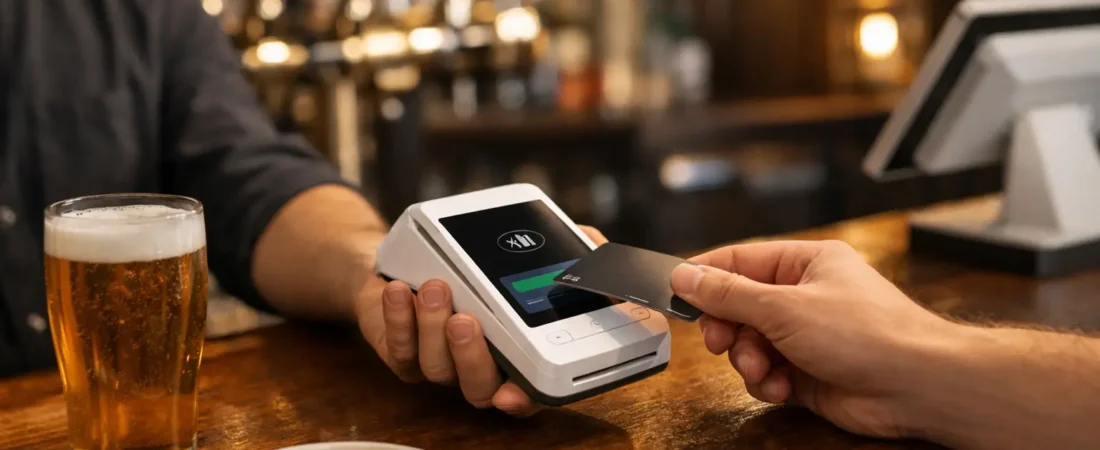
However, many pubs now take food orders at tables, run garden areas, or serve customers in separate rooms. In those settings, portable card machines are often more useful. Staff can take payment where the customer is sitting rather than asking them to come back to the bar. That can free up the bar area, shorten queues, and make the experience feel more attentive.
A portable terminal should have dependable Wi-Fi or mobile connectivity throughout the building and outside spaces. Before choosing one, test coverage in the cellar, beer garden, function room, and any areas where staff may take payments. A terminal is only convenient when it works where your customers are.
For some pubs, the sensible setup is a mix: a fixed terminal at the main bar and one or more portable devices for tables and outdoor service. This avoids putting every payment through one device during the busiest hour.
Start with the payment journey, not the machine
Think through a typical Saturday from opening to close. How do customers order? Do they pay immediately, start a tab, split a bill, or pay at the end of a meal? Does a member of staff need to check an order before taking payment? The answers point toward the right level of system.
A standalone card machine can take contactless, chip and PIN, and mobile wallet payments. It can be a good fit for a small wet-led pub where transactions are simple. It is also useful as a backup terminal, even where a larger system is in place.
Once food, table service, tabs, and multiple staff members are involved, payment needs to work closely with the point of sale. An integrated EPOS setup sends the total directly from the till or handheld ordering device to the card terminal. Staff do not have to key the amount in twice. That may seem like a small change, but it can reduce keying errors during a hectic shift and make end-of-day reconciliation easier.
When integrated EPOS makes sense
A card machine becomes more valuable when it is part of a practical pub management setup. With integrated payments and EPOS, the order, bill, and payment record sit together. Managers can see what has sold, who has paid, and which tabs remain open without searching across separate systems.
This is particularly helpful for pubs with food service. A handheld device can allow a staff member to take an order at the table, send it to the kitchen display or printer, and take payment when the meal is finished. It removes repeated trips to the bar and cuts down on handwritten notes or verbal messages.
Table management can also help staff see which tables are seated, ordering, waiting for food, or ready to pay. For a pub with a dining room, this gives a clearer picture of service without adding unnecessary complexity.
Stock control and reporting are worth considering too, although not every venue needs every feature from day one. If you regularly lose time checking what sold, reconciling tills, or working out which menu items perform well, an EPOS system can provide useful information. The aim is not more reports for their own sake. It is quicker decisions about staffing, ordering, pricing, and service.
What card machine should a pub use for busy periods?
At peak times, speed and reliability matter more than extra features you will never use. A pub should have enough payment capacity to avoid a queue building because one terminal is in use at a table or needs charging.
For many independent venues, one countertop device and one portable device is a sensible starting point. A larger pub, or one with a beer garden and regular food service, may need additional portable terminals so staff are not sharing a single device. The number depends on your busiest service pattern, not your quietest Tuesday afternoon.
Battery life matters for portable machines. Choose a charging routine so devices start service fully charged, and make sure staff know where they belong between shifts. It is also wise to have a clear fallback plan if Wi-Fi drops or a device is damaged. A backup connection or spare terminal can prevent a minor technical issue from becoming lost sales on a busy night.
Consider costs alongside cash flow
The cost of a card machine is more than the purchase price. Look at transaction pricing, any monthly software costs, optional hardware, and whether the system requires a long contract. Straightforward pricing helps a pub understand its payment costs as sales change through the year.
Payout timing can matter just as much. Pubs have regular outgoings for stock, wages, utilities, and suppliers. Faster access to card takings can make cash flow easier to manage, especially after a strong weekend or bank holiday. Same-day payouts, including weekends and bank holidays where available, can be a practical benefit rather than a technical detail.
Do not choose solely on the lowest advertised rate. A cheaper-looking arrangement can become expensive in staff time if payments are entered manually, totals do not match, or the system makes reporting difficult. Equally, a full EPOS setup is not automatically right for a small pub with a simple operation. Match the cost and features to a genuine business need.
Features that help pubs serve customers better
Customers increasingly expect to pay quickly using contactless cards, phones, and watches. Your setup should make those payments easy without making staff jump between systems. It should also handle the everyday requests that slow service if the process is unclear, such as splitting a bill, taking a deposit, or settling a table tab.
QR payments can be useful for certain venues, particularly outdoor areas or busy events, but they should support rather than replace good service. Some customers prefer to order and pay from their phone; others want to speak to a member of staff. A flexible pub can offer both without forcing every customer down one route.
Loyalty tools may also be worth considering if you have regular local customers. A straightforward loyalty offer can encourage repeat visits, but only if it is easy for staff and customers to use. Complicated schemes often create more questions at the bar than value for the business.
Ask for a demonstration before deciding
The useful question is not only, “What card machine should a pub use?” It is also, “Can my team use this confidently on a busy shift?” A demonstration lets you test the real tasks: opening a tab, sending a food order, splitting a payment, printing a receipt, and checking the daily takings.
Ask how installation, staff training, and ongoing support will work. Local, face-to-face help can be especially useful when changing a payment or EPOS setup, because the system needs to fit your bar layout, connectivity, menus, and staff routines. It also gives you someone to call when you want to add a terminal, change a workflow, or understand a report.
Richard Bradley at Dorset Business Hub can review your current arrangement, discuss practical options, and demonstrate suitable payment and EPOS setups for independent pubs. For a friendly, no-obligation conversation, call 07377 625228 or use the Dorset Business Hub contact page. The right setup should leave your staff with less admin to manage and more time to look after the people at the bar.