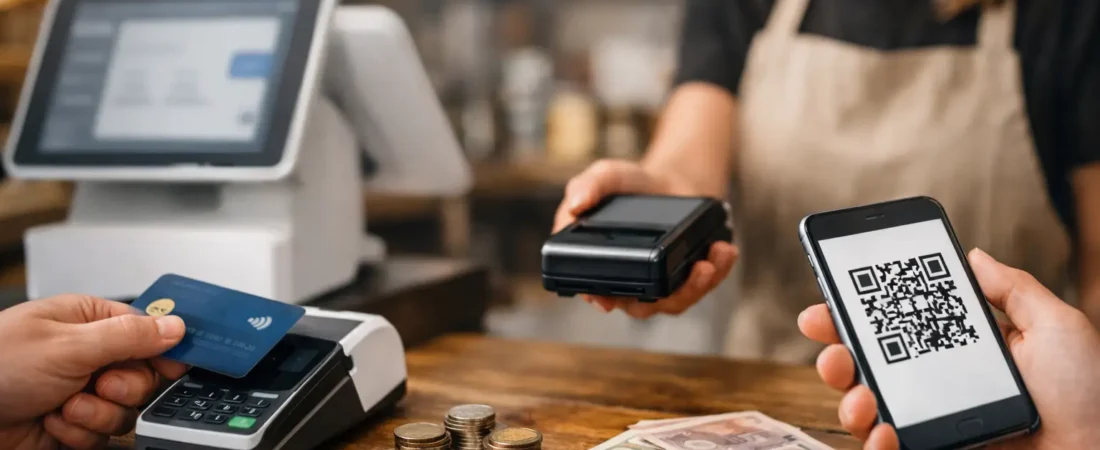
A card payment that appears to cost 1.5% can cost considerably more once monthly charges, terminal rental, PCI fees, minimum charges, and add-on services are included. That is why a proper fee payment comparison should look beyond the headline transaction rate. For a busy cafe, salon, shop, or trades business, the right choice is usually the provider whose overall costs and day-to-day tools suit the way the business actually operates.
Why a fee payment comparison needs more than one rate
Payment providers often quote a percentage fee for card transactions. This is useful, but it is only one part of the picture. A business taking $20,000 per month by card will naturally focus on a difference of a few tenths of a percent. A business taking occasional card payments may care more about avoiding fixed monthly costs.
The useful question is not simply, “Which rate is lower?” It is, “What will I pay over a typical month, and what will I receive for that cost?”
For example, a coffee shop with frequent low-value transactions may benefit from a straightforward rate and a fast countertop terminal. A restaurant may need tipping, table management, multiple devices, and an EPOS system that keeps orders moving. A plumber may place greater value on payment links, invoices, and a portable reader than on advanced in-store features.
Comparing providers in this way prevents a low advertised rate from becoming an expensive arrangement in practice.
The costs to include in your fee payment comparison
Start by gathering a recent month or, ideally, three months of merchant statements. Use real figures rather than estimates wherever possible. Then compare each provider using the same information: card sales volume, number of transactions, average transaction value, payment methods, and any recurring charges.
Transaction fees
Transaction fees are usually charged as a percentage of each sale, sometimes with an additional fixed amount per transaction. Ask whether the rate is the same for debit cards, credit cards, contactless payments, online payments, payment links, and manually entered transactions.
A single flat rate is easy to understand and budget for. Other pricing models may offer different rates based on card type or sales volume. Neither approach is automatically right for every business. The key is being able to predict your effective cost from your own sales pattern.
If you run a bakery and take hundreds of small payments each week, even a small fixed fee per transaction can have an effect. If you own a guest house and take fewer, higher-value deposits, the percentage rate and online payment cost may matter more.
Monthly, terminal, and account charges
A lower transaction rate can come with regular fixed charges. These may include a monthly account fee, terminal rental, software subscription, reporting package, SIM or connectivity fee, support plan, or a fee for additional users.
Add every fixed charge to your calculation. A provider costing $45 per month before a single payment is taken needs to deliver enough savings or useful functionality to justify that commitment.
Buying a card terminal outright can be attractive for a small independent business because it makes the hardware cost clear. Renting may suit a business that needs replacement equipment included or prefers to spread the cost. Check what happens if you stop using the service, change device, or need an additional terminal during a busy season.
Online, invoice, and remote payment charges
Many businesses now take deposits, settle invoices remotely, or send payment links after completing work. These transactions may be priced differently from payments taken in person.
For a tradesperson, a payment link sent when a job is complete can reduce the time spent chasing payment. For a hotel or salon, online deposits can reduce no-shows. The relevant comparison is not only the fee itself but also whether the method improves cash flow and saves staff time.
Make sure the quote covers the payment methods you intend to use. A low in-person card rate does not tell you much if a growing share of your income comes through online invoices or booking deposits.
Contract length and exit costs
Before agreeing to a rate, check the commitment. Some services operate on a flexible, pay-as-you-go basis. Others offer contracted pricing that may include a minimum term, notice period, early termination charge, or equipment return requirement.
A contract can be sensible when it provides a clear benefit and you are comfortable with the commitment. However, it should be understood before signing, particularly for seasonal businesses or those planning to move premises, add locations, or change their EPOS system.
Ask for the full pricing schedule in writing and look for charges that apply when account activity is low, payments are refunded, or a terminal needs replacing. Clear pricing is easier to manage than a cheap-looking offer with conditions hidden in the detail.
Compare the total monthly cost, not just the percentage
A simple calculation makes a fee payment comparison much more practical:
Total monthly payment cost = transaction fees + fixed monthly charges + relevant service fees
Suppose a boutique takes $15,000 in card payments each month. Provider A charges 1.60% with no monthly fee. Provider B charges 1.25% plus a $55 monthly service fee.
Provider A would cost about $240 per month. Provider B would cost about $242.50. Despite the lower percentage rate, Provider B is slightly more expensive at that sales level. If card sales rise, the calculation can change. If the boutique also needs software included in the monthly fee, that can change the value again.
This is why owners should compare like with like. Include only services you will genuinely use, and do not assume that the lowest rate is the lowest overall cost.
Put operational value alongside the fees
Payment costs matter, but so does the time your team spends taking payments, correcting orders, closing the till, and reconciling sales. A system that reduces errors or shortens the queue may be worth a little more than the lowest-cost option. Equally, a feature-heavy package can be unnecessary expense if you only need a reliable card reader and basic sales reports.
When comparing solutions, consider whether you need:
- A portable terminal for tables, market stalls, deliveries, or work on site
- An EPOS system for product buttons, stock, staff permissions, and sales reporting
- Digital receipts, tipping, split bills, or gift cards
- Payment links, invoices, QR code payments, or online checkout
- Booking, loyalty, or customer communication tools
Think about the customer experience too. A restaurant may need fast table-side payment at peak times. A salon may want deposits and automated booking reminders. A farm shop may need stock control that works alongside the card terminal. The payment solution should support the work, not create another task for staff.
Questions to ask before switching providers
A provider should be able to answer straightforward pricing questions clearly. Ask what you will pay each month at your current transaction volume, whether rates vary by card type or payment channel, and whether there are any minimums or additional account charges.
It is also sensible to ask how quickly funds are available, what support is included, how refunds are handled, and whether your existing till, printer, or booking system can work with the new setup. A low-cost option can become inconvenient if it creates manual work at the end of every day.
If you are considering an EPOS package, request a demonstration based on your own business. A cafe should see menu changes, modifiers, and split bills. A retailer should see product setup, barcode scanning, discounts, and reports. A trades business should see how quickly it can take a payment after an invoice is sent.
Review payment costs regularly
Payment needs change as a business grows. A single terminal may be enough when a shop opens, but a second device can become essential during busy periods. A pub that adds food service may need table ordering. A trades business that starts employing more staff may need a clearer way to track invoices and payments.
Review your arrangement at least once a year, and sooner if card sales have changed significantly or you are paying for features that are no longer used. Keep the review focused on the full cost, the practical workflow, and the level of support available when something needs attention.
For independent businesses, the most useful payment setup is rarely the one with the most features or the lowest headline rate. It is the one that gives you clear costs, dependable tools, and less administration around every sale. If you would like an honest review of your current payment or EPOS setup, Richard Bradley can help you compare the options and identify what fits your business without pressure or obligation.

Let’s Talk About Your Business
Hi, I’m Richard Bradley, your local SumUp Business Partner .
I help independent businesses across Dorset reduce card payment costs, choose the right card machines and EPOS systems, and receive honest, local advice.
Questions about this article? Looking to reduce your card payment costs? Book your free, no-obligation payment review today.
✓ Local Dorset Business Partner ✓ Free Payment Review ✓ No Obligation
Book Your Free Payment Review