A card machine is no longer just something placed beside the cash register. For a busy coffee shop, salon, retail store, pub, or trades business, it affects how quickly customers pay, how smoothly staff work, and how clearly you can track money coming in. The right choice should make everyday payments simpler without adding costs or features your business will never use.
Many independent owners start by comparing the upfront price of a terminal. That matters, but it is only one part of the decision. Transaction fees, connection options, battery life, payment methods, reporting, and the support available when something goes wrong can have a much bigger effect over time.
Start With How You Take Payments
Before comparing models, look at the moments when customers pay you. A bakery with a fixed counter has different needs from a plumber collecting payment at a customer’s home. A restaurant may need several handheld devices for table service, while a boutique may want one portable terminal to use at the counter and around the store.
Ask a few practical questions. Are most payments taken in one place or on the move? Do staff need to split bills, add tips, or take deposits? Is mobile signal reliable where you work? Do you need to accept payments at events, markets, or pop-up locations?
Your answers will narrow the options quickly. A simple portable reader can suit a low-volume business that only needs occasional card payments. A standalone terminal with its own Wi-Fi or mobile data connection is usually more convenient for businesses taking payments throughout the day. If payment taking is tied closely to orders, inventory, staff, or tables, a point-of-sale setup may be a better fit than a terminal alone.
Choosing a Card Machine That Fits Daily Work
The most suitable card machine is the one your team can use confidently during a busy shift. It should not create extra steps at the counter or leave staff searching for a phone, charger, or unreliable connection.
Connection and portability
Some card readers connect to a smartphone or tablet through Bluetooth. They can be cost-effective and useful for mobile work, but they rely on the paired device being charged, nearby, and connected. That may be perfectly reasonable for a self-employed tradesperson taking a few payments each week.
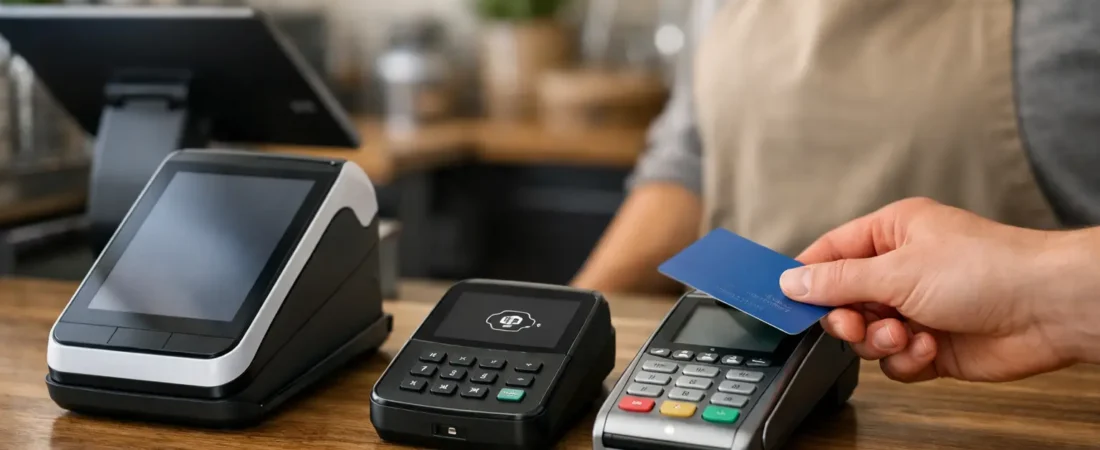
Standalone terminals are often more practical for cafés, salons, shops, and hospitality businesses. They have a built-in screen and connection, so staff can take payment without using a separate phone. A portable terminal can also help reduce lines by allowing payment at the table, at a queue, or wherever the customer is standing.
Think realistically about your premises. Thick walls, outdoor seating, basement areas, and market locations can all affect connectivity. Wi-Fi may be enough in a small store, while a device with mobile data can provide more flexibility for businesses that move around or work off-site.
Payment methods customers expect
Contactless payments are now routine, but customers may also use chip and PIN, mobile wallets, payment links, QR codes, or online checkout. You do not need every possible method, but the ones you offer should match how your customers buy.
For example, a decorator may benefit from sending a payment link after completing work. A guest house may need to take deposits before arrival. A café could use QR code ordering or payment during a busy summer period. A retail store may simply need a fast, reliable contactless experience at the counter.
The useful question is not, “What can this device do?” It is, “Which payment options will save time for my customers and staff?”
Speed, battery, and everyday durability
A terminal that works well in a quiet demonstration may feel very different during Saturday lunch service. Check how quickly it wakes up, prints or sends receipts, and moves between screens. If you take payments away from a power outlet, consider battery life and how easily the device can be charged between shifts.
For businesses with frequent use, it is also worth considering a charging dock, receipt printer, or protective case where appropriate. These are not essential for everyone, but they can make a difference in a high-volume environment.
Look Beyond the Terminal Price
An inexpensive device can be good value, but only if the wider costs suit your business. Payment costs are often easier to manage when pricing is clear and you understand what is included.
Review the transaction rate, whether there is a monthly subscription, and whether different rates apply to certain payment types. Also check practical details such as chargeback handling, refunds, payout timing, and any charges for optional features. The aim is not simply to find the lowest advertised rate. It is to understand the likely cost based on your own sales pattern.
A business taking a small number of higher-value payments may prefer a different arrangement from a busy café processing hundreds of lower-value transactions each week. Likewise, a business with strong seasonal trade should avoid paying for capacity or software it does not need during quieter months.
Keep an eye on the value of time as well. If a more suitable setup reduces manual keying, shortens checkout lines, or removes the need to reconcile separate payment records at the end of the day, that can be worth more than a small difference in terminal price.
When a Card Machine Should Connect to POS
A standalone terminal is often all a business needs. However, when staff regularly enter orders, manage inventory, issue receipts, or track sales by employee, connecting payments with a point-of-sale system can reduce repeated work.
In a restaurant, an integrated setup can send the correct bill to the payment terminal rather than requiring staff to type the amount again. In a retail shop, it can update inventory as products are sold. In a salon, it may connect appointments, customer details, payments, and loyalty activity in one place.
There is a trade-off. A more complete POS setup can improve reporting and efficiency, but it requires careful setup and staff training. Smaller businesses should not assume they need a large system simply because it has more features. Start with the bottleneck you want to fix, whether that is slow checkout, stock control, table management, or end-of-day admin.
Avoid Common Buying Mistakes
The most common mistake is choosing a device before defining the problem. A terminal may look modern and have a long list of functions, but that does not mean it fits your service style.
It is also easy to overlook the people using it. If multiple staff members take payments, make sure the process is clear and that everyone knows how to issue refunds, find receipts, and handle connection problems. A short practical handover can prevent avoidable disruption later.
Finally, do not treat payment acceptance as separate from cash flow. Check when funds become available in your business account and how your payment records will be matched to sales, invoices, or bookings. Clear reporting makes it easier to spot errors and understand what is selling, without turning the owner into an accountant.
A Simple Way to Compare Options
When reviewing card machine options, compare them against the same real-life checklist: where payments are taken, the number of transactions, average sale value, connection needs, staff workflow, payment methods, and the total ongoing cost. Then consider what support you would receive if you need help setting up or expanding the system.
For many independent businesses, local advice is valuable because the right answer depends on the counter layout, customer flow, and day-to-day routines. A terminal that works well for a seaside café may not be the sensible choice for a mobile electrician or a small hotel taking advance bookings.
If you run a business in Dorset or the surrounding area and are unsure whether your current payment setup is costing more time or money than it should, Richard Bradley can provide a free, no-obligation payment and POS review. A short conversation can help you identify a practical next step, whether that means keeping things simple, changing your terminal, or connecting payments with the rest of your business operations.

Let’s Talk About Your Business
Hi, I’m Richard Bradley, your local SumUp Business Partner .
I help independent businesses across Dorset reduce card payment costs, choose the right card machines and EPOS systems, and receive honest, local advice.
Questions about this article? Looking to reduce your card payment costs? Book your free, no-obligation payment review today.
✓ Local Dorset Business Partner ✓ Free Payment Review ✓ No Obligation
Book Your Free Payment Review